
Memory prices soared by 90% in the first quarter, and institutions expect industry profitability to reach a new high

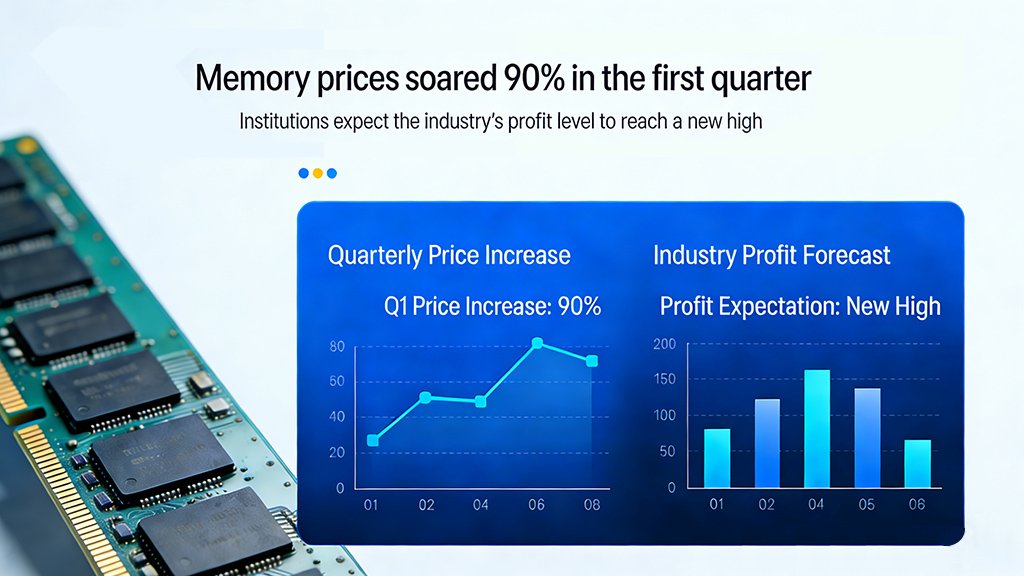
On February 9th, the “February Memory Price Tracking Report” released by Counterpoint, a third-party market research organization, indicated that compared to the fourth quarter of 2025, memory prices have surged by 80%-90% as of the first quarter of 2026, with DRAM, NAND, and HBM all reaching record highs.
Counterpoint points out that the main driver of this round of increase is the significant surge in the prices of general-purpose server DRAM. Furthermore, NAND flash memory, which had a relatively stable performance in the fourth quarter, also saw a simultaneous increase of 80%–90% in the first quarter. Coupled with the higher prices of some HBM3e products, the market is experiencing a comprehensive acceleration of price increases across all categories and sectors.
Due to the surge in DRAM prices, Counterpoint stated in its report that by the fourth quarter of 2025, the profit margin of traditional DRAM had surpassed that of HBM. It is expected that in the first quarter of 2026, the operating profit margin of manufacturers will reach a historical peak, achieving a record-breaking profit level.
Taking server-level memory as an example, the contract price of 64GB RDIMM has soared from $450 in the fourth quarter of last year to over $900 in the first quarter of this year, and is expected to exceed the $1,000 mark in the second quarter.
In addition, Goldman Sachs recently significantly raised its expectations for the shortage of DRAM supply. The latest forecast shows that the demand-supply gap for DRAM will reach 4.9% and 2.5% in 2026 and 2027, far exceeding the previous expectations of 3.3% and 1.1%. Among them, “the supply shortage in 2026 will be the most severe in the past 15 years.”
However, the rise in memory chip prices has exerted significant pressure on original equipment manufacturers (OEMs).
Jeongku Choi, a senior analyst at Counterpoint, emphasized: “For device manufacturers, this is a double blow – the rising cost of components coupled with weakening consumer purchasing power, and demand is likely to slow down as the quarter progresses. This requires original equipment manufacturers (OEMs) to change their procurement models, or focus on high-end models, and support higher product pricing by providing more value to consumers.”. ”
Counterpoint points out that smartphone manufacturers are reducing the DRAM capacity of their devices or adopting the more cost-effective QLC solution to replace TLC solid-state drives. At the same time, orders for LPDDR4, which are currently in short supply, have significantly declined, while new entry-level chips supporting the latest DRAM standards have been launched one after another, driving the continuous growth of LPDDR5 orders.
In addition to the reduction in memory configuration, due to weak market demand, major mobile phone manufacturers have reported a downward adjustment in their annual mobile phone shipment volumes this year.
Jeongku Choi further pointed out: “The profitability level of the memory industry is expected to reach unprecedented heights. In the fourth quarter of 2025, the operating profit margin of DRAM has reached the 60% range, which is the first time that the general-purpose DRAM profit margin has surpassed HBM. In the first quarter of 2026, the DRAM profit margin will exceed its historical peak for the first time. Nevertheless, this level will either become the new normal or form an extremely high benchmark – it seems solid at present, but once the next downturn cycle occurs (if it does), the market performance may be even more dismal.”. ”
(Source: The Paper)